<html>
<head>
<title>Fatherloss by Neil Chethik</title>
<meta http-equiv="Content-Type" content="text/html; charset=iso-8859-1">
<script language="JavaScript">
<!--
function MM_preloadImages() { //v3.0
  var d=document; if(d.images){ if(!d.MM_p) d.MM_p=new Array();
    var i,j=d.MM_p.length,a=MM_preloadImages.arguments; for(i=0; i<a.length; i++)
    if (a[i].indexOf("#")!=0){ d.MM_p[j]=new Image; d.MM_p[j++].src=a[i];}}
}

function MM_swapImgRestore() { //v3.0
  var i,x,a=document.MM_sr; for(i=0;a&&i<a.length&&(x=a[i])&&x.oSrc;i++) x.src=x.oSrc;
}

function MM_findObj(n, d) { //v3.0
  var p,i,x;  if(!d) d=document; if((p=n.indexOf("?"))>0&&parent.frames.length) {
    d=parent.frames[n.substring(p+1)].document; n=n.substring(0,p);}
  if(!(x=d[n])&&d.all) x=d.all[n]; for (i=0;!x&&i<d.forms.length;i++) x=d.forms[i][n];
  for(i=0;!x&&d.layers&&i<d.layers.length;i++) x=MM_findObj(n,d.layers[i].document); return x;
}

function MM_swapImage() { //v3.0
  var i,j=0,x,a=MM_swapImage.arguments; document.MM_sr=new Array; for(i=0;i<(a.length-2);i+=3)
   if ((x=MM_findObj(a[i]))!=null){document.MM_sr[j++]=x; if(!x.oSrc) x.oSrc=x.src; x.src=a[i+2];}
}

function MM_openBrWindow(theURL,winName,features) { //v2.0
  window.open(theURL,winName,features);
}
//-->
</script>
</head>

<body bgcolor="#000000" onLoad="MM_preloadImages('images/booksense_on.gif','images/intro_on.gif','images/about_on.gif','images/speaking_on.gif','images/reader_on.gif','images/survey_on.gif','images/links_on.gif','images/auto_on.gif','images/amazon_on.gif','images/bn_on.gif')" text="#000000" link="#990000" vlink="#990000" alink="#990000">
<div id="Layer1" style="position:absolute; left:354px; top:154px; width:149px; height:127px; z-index:1"><img src="images/nchet.jpg" width="144" height="125" border="1"></div>
<table width="650" border="0" cellspacing="0" cellpadding="0" align="left">
  <tr valign="top"> 
    <td> 
      <table width="646" border="0" cellspacing="0" cellpadding="0" vspace="0" hspace="0" align="center">
        <tr> 
          <td colspan="3" valign="top"><a href="index.htm"><img src="images/masthead1.gif" width="100" height="77" border="0"><img src="images/masthead2.gif" width="100" height="77" border="0"><img src="images/masthead3.gif" width="100" height="77" border="0"><img src="images/masthead4.gif" width="100" height="77" border="0"><img src="images/masthead5.gif" width="100" height="77" border="0"><img src="images/masthead6.gif" height="77" border="0"></a><br>
            <a href="intro.html" onMouseOut="MM_swapImgRestore()" onMouseOver="MM_swapImage('intro','','images/intro_on.gif',1)"><img src="images/intro.gif" width="102" height="30" name="intro" border="0"></a><a href="about.html" onMouseOut="MM_swapImgRestore()" onMouseOver="MM_swapImage('about','','images/about_on.gif',1)"><img src="images/about_on.gif" width="129" height="30" name="about" border="0"></a><a href="speaking.html" onMouseOut="MM_swapImgRestore()" onMouseOver="MM_swapImage('speak','','images/speaking_on.gif',1)"><img src="images/speaking.gif" width="130" height="30" name="speak" border="0"></a><a href="reader.html" onMouseOut="MM_swapImgRestore()" onMouseOver="MM_swapImage('reader','','images/reader_on.gif',1)"><img src="images/reader.gif" width="121" height="30" name="reader" border="0"></a><a href="survey.html" onMouseOut="MM_swapImgRestore()" onMouseOver="MM_swapImage('survey','','images/survey_on.gif',1)"><img src="images/survey.gif" width="109" height="30" name="survey" border="0"></a><a href="index.htm" onMouseOut="MM_swapImgRestore()" onMouseOver="MM_swapImage('Image1','','images/links_on.gif',1)"><img src="images/links.gif" height="30" border="0" name="Image1"></a></td>
        </tr>
        <td width="59" valign="top"><img src="images/sunsleft.gif" height="144" width="59"><br>
          <img src="images/waterl1.gif" width="58" height="100"><br>
          <img src="images/waterl2.gif" width="58" height="133"> </td>
        <td width="397" valign="top" bgcolor="F8D96A"> 
          <table width="391" border="0" cellspacing="0" cellpadding="0">
            <tr> 
              <td width="13">&nbsp;</td>
              <td width="378">&nbsp;</td>
            </tr>
            <tr> 
              <td width="13">&nbsp;</td>
                <td width="378" valign="top"> 
                  <p> <img src="images/runaround.gif" width="130" height="161" align="right"><font size="2" face="Arial, Helvetica, sans-serif"><b><font size="3">ABOUT 
                    THE AUTHOR</font> </b></font></p>
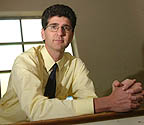
                  <p><font size="2" face="Arial, Helvetica, sans-serif">Neil Chethik 
                    is a writer, professional speaker, and workshop leader living 
                    in Lexington, Ky. For the past decade, he has focused his 
                    work on the psychology of men. Between 1992 and 1996, he wrote 
                    VoiceMale, a weekly column on men's issues, which was syndicated 
                    to dozens of newspapers by Universal Press Syndicate. In 1996, 
                    he retired the column to focus on book-writing and speaking. 
                    </font></p>
                  <p><font size="2" face="Arial, Helvetica, sans-serif">Chethik 
                    was born in 1957 in Cleveland, Ohio, and grew up primarily 
                    in Ann Arbor, Mich., where his father was on the faculty the 
                    University of Michigan's School of Psychiatry. Neil got his 
                    bachelor's degree in journalism in 1979 from Northwestern 
                    University's Medill School of Journalism. He worked on the 
                    staffs of the Tallahassee Democrat and San Jose Mercury News 
                    before going out on his own in 1991.</font></p>
                  <p><font size="2" face="Arial, Helvetica, sans-serif"> Now 43, 
                    Neil lives in the Kentucky bluegrass region with his wife, 
                    Kelly Flood, who is a professional fund-raiser, and their 
                    7-year-old son, Evan. <i>FatherLoss</i> is his first book. 
                    <br>
                    <br>
                    </font></p>
                  <p><font size="3" face="Arial, Helvetica, sans-serif"><b>Q & 
                    A WITH NEIL CHETHIK </b></font></p>
                  <p><font size="2" face="Arial, Helvetica, sans-serif"><b>Q: 
                    How did you get interested in the topic of father-loss?</b></font></p>
                  <p><font size="2" face="Arial, Helvetica, sans-serif"> A: In 
                    1984, when I was 27 years old, my paternal grandfather died 
                    suddenly. I was living a few blocks from him at the time. 
                    My father came to town the next day, and we spent an afternoon 
                    going through my grandfather's apartment. That was the first 
                    time I ever saw my father cry. My father told me that day 
                    that he cried in part because he'd always wanted to hear some 
                    words of pride from his father, and now he never would. Then 
                    my father said he didn't want me to feel the same way when 
                    he died, so he told me how proud he was of me. That was the 
                    seed for <i>FatherLoss</i>. </font></p>
                  <p><font size="2" face="Arial, Helvetica, sans-serif"><b>Q: 
                    Has your father passed away since then? </b></font></p>
                  <p><font size="2" face="Arial, Helvetica, sans-serif">A: No. 
                    He's 69 and healthy. When I first told him I was writing about 
                    the death of fathers, I was afraid he might take it wrong, 
                    like I was pushing him toward the grave. Instead, he was very 
                    supportive, and became intimately involved in helping me with 
                    the book. He's a psychoanalyst, and we spent hours together 
                    exploring his relationship with his father, his relationship 
                    with me, and the stories of the men I interviewed. </font></p>
                  <p><font size="2" face="Arial, Helvetica, sans-serif"><b>Q: 
                    You interviewed 70 men for the book. How did you find them?</b></font></p>
                  <p><font size="2" face="Arial, Helvetica, sans-serif">A: I started 
                    with a handful of people I already knew who had lost their 
                    fathers. I then contacted a few of the thousands of men who 
                    had written to me when I was a syndicated columnist in the 
                    mid-90s. Then I reached out to churches, hospices, and other 
                    civic groups to help balance my interviewees by age, race, 
                    ethnicity, sexual orientation, and other characteristics. 
                    I traveled to every region of the country to conduct the interviews. 
                    </font></p>
                  <p><font size="2" face="Arial, Helvetica, sans-serif"><b>Q: 
                    Men are notorious for not talking about emotions. Did you 
                    have trouble getting them to talk? </b></font></p>
                  <p><font size="2" face="Arial, Helvetica, sans-serif">A: Not 
                    at all. None of the men I sat down with was reluctant to talk. 
                    And all but two of the men I asked for interviews said yes. 
                    I think the key to talking with men about emotional subjects 
                    is to avoid asking: How did you feel? but rather, to ask: 
                    What happened next? The men I spoke with wanted to tell their 
                    stories. </font></p>
                  <p><font size="2" face="Arial, Helvetica, sans-serif"><b>Q: 
                    What was most striking to you about these men? </b></font></p>
                  <p><font size="2" face="Arial, Helvetica, sans-serif">A: The 
                    intensity of their connection to their fathers. Even when 
                    a father had been dead for decades, sons spoke with passion, 
                    reverence, sadness, anger. It may seem that fathers and sons 
                    don't communicate much, but there's usually a tremendous depth 
                    of feeling between them. </font></p>
                  <p><font size="2" face="Arial, Helvetica, sans-serif"><b>Q: 
                    Is the father-son connection different from other parent-child 
                    bonds? </b></font></p>
                  <p><font size="2" face="Arial, Helvetica, sans-serif">A: I think 
                    it is. The father-son relationship may be closest to the mother-daughter 
                    bond. Children look to the same-sex parent for guidance and 
                    acceptance. I found that when a father didn't offer these 
                    things to a son, the son was deeply hurt. He often went through 
                    adult life looking for acceptance from other men, especially 
                    male bosses. When a man has a rough time with his male boss, 
                    you can almost guarantee he's had a rough time with his dad. 
                    </font></p>
                  <p><font size="2" face="Arial, Helvetica, sans-serif"><b>Q: 
                    You commissioned a national telephone survey of 300 men. Why 
                    did you do that, and what did you find?</b> </font></p>
                  <p><font size="2" face="Arial, Helvetica, sans-serif">A: We 
                    commissioned the survey because we wanted some hard numbers 
                    to go along with the in-depth stories, and because we wanted 
                    a representative sample. A university research center conducted 
                    the survey. And the findings are fascinating. We found, for 
                    example, that 61 percent of sons cry over the death of their 
                    fathers – but that crying is not a significant factor in how 
                    effectively a son copes with his father's death. A far more 
                    important factor is what kind of relationship he had with 
                    his father while growing up. Generally, the worse the relationship 
                    between a father and son while growing up, the harder it is 
                    for the son to deal with the death. </font></p>
                  <p><font size="2" face="Arial, Helvetica, sans-serif"><b>Q: 
                    What did you learn, if anything, about how men grieve differently 
                    from women?</b></font></p>
                  <p><font size="2" face="Arial, Helvetica, sans-serif"> A: I 
                    found that generally speaking, men and women do grieve differently. 
                    Women are more likely to be emotionally expressive – they 
                    cry more easily, and talk about the loss more easily. Men 
                    are quieter, more intellectual. They're also action-oriented 
                    in their grief. In place of crying, some men run, chop wood, 
                    work out with weights. These act as releases. Then they often 
                    take action that honors the memory of their fathers. One man 
                    I spoke with built an urn in his father's wood shop after 
                    the death, using his dad's tools; another planted a tree in 
                    his father's honor. In this way, sons touch their grief and 
                    let it out a little at a time. </font></p>
                  <p><font size="2" face="Arial, Helvetica, sans-serif"><b>Q: 
                    Does that kind of grieving really work?</b> </font></p>
                  <p><font size="2" face="Arial, Helvetica, sans-serif">A: Absolutely. 
                    One of the surprises in my research was discovering previous 
                    studies that compared how men and women grieved. Almost across 
                    the board, they found that while the sexes grieve differently, 
                    neither gender does it more effectively than the other. In 
                    fact, that's a major message of my book: Don't let anybody 
                    else tell you how to grieve! </font></p>
                  <p><font size="2" face="Arial, Helvetica, sans-serif"><b>Q: 
                    You mean that any style of grief is OK?</b></font></p>
                  <p><font size="2" face="Arial, Helvetica, sans-serif"> A: Not 
                    exactly. People make mistakes as they grieve, hurting themselves 
                    or others. For example, 12 percent of the men in my survey 
                    said they used drugs or alcohol to cope with the death, and 
                    most of them said that in the long run, it hurt them. My suggestion 
                    for those facing a loss is to allow the grieving process to 
                    happen naturally&#151;but also to monitor themselves. After 
                    a few weeks or months, they can ask themselves if their relationships 
                    are suffering, if their work life has taken a dive, if their 
                    overall mood isn't improving. Grieving a significant loss 
                    can take months, or longer, with lots of dips and dives. Eventually, 
                    if someone senses that they're stuck, it's probably worth 
                    considering professional help. </font></p>
                  <p><font size="2" face="Arial, Helvetica, sans-serif"><b>Q: 
                    How can a professional help someone grieve? </b></font></p>
                  <p><font size="2" face="Arial, Helvetica, sans-serif">A: There 
                    are counselors, ministers, and others who specialize in helping 
                    people move through a loss. But often, just having someone 
                    to talk with who is not a family member or friend can break 
                    the logjam. At the end of most of the interviews I conducted 
                    for the book, I asked the man what had helped him most in 
                    dealing with his father's death. More than a few said talking 
                    with me. </font></p>
                  <p><font size="2" face="Arial, Helvetica, sans-serif"><b>Q: 
                    You're the father of a 7-year-old boy. Did writing this book 
                    teach you anything about being a father? </b></font></p>
                  <p><font size="2" face="Arial, Helvetica, sans-serif">A: It 
                    helped me immensely. For one, I learned the importance of 
                    affection. I asked each man I interviewed to recall what his 
                    father did that made him feel valued. The answer, overwhelmingly, 
                    was affection. And that wasn't limited to physical affection. 
                    Fathers who played games with their kids, helped with homework, 
                    took their sons to sporting events&#151;all of that had a 
                    similar impact to physical affection. The important thing 
                    is for a father to focus his loving attention on his son&#151;not 
                    in a controlling way, but rather in a way that allows the 
                    son to take the lead. I also learned the importance of talking 
                    about death and loss with young children. When a family cat 
                    dies, for example, we can encourage&#151;though not force&#151;children 
                    to help with the burial or a memorial, and then we should 
                    talk about the loss whenever the child wants to. Experience 
                    with death is a great preparation for life. </font></p>
                  <p><font size="2" face="Arial, Helvetica, sans-serif"><b>Q: 
                    You worked on <i>FatherLoss</i> for three-and-a-half years. 
                    Did immersing yourself in death ever leave you depressed? 
                    </b></font></p>
                  <p><font size="2" face="Arial, Helvetica, sans-serif">A: I had 
                    my moments. Once I conducted two interviews in one day, totaling 
                    eight hours. I ended up with the worst headache of my life. 
                    Digging so deeply, churning up so much, it was overwhelming. 
                    But overall, the book has lifted me up. I'm not nearly as 
                    afraid of death as I was before I started, and I have a greater 
                    appreciation for life. </font></p>
                <p>&nbsp;</p>
                <p align="center"><b><font face="Arial, Helvetica, sans-serif" size="2"><a href="intro.html">Book 
                  Excerpt</a> | <a href="about.html">About the Author</a> | <a href="speaking.html">Speaking 
                  Schedule</a><br>
                    <a href="reader.html">Reader Feedback</a> | <a href="survey.html">Survey 
                    Results</a> | <a href="index.htm">Home</a></font></b></p>
                <p align="center">&nbsp;</p>
                <p align="center">&nbsp;</p>
              </td>
            </tr>
          </table>
        </td>
          <td width="190" valign="top"> 
            <div align="left"><img src="images/sunsr1.gif" height="144"><img src="images/sunsr2.gif" width="50" height="144"><img src="images/sunsr3.gif" width="50" height="144"><img src="images/sunsr4.gif" width="33" height="144"><br>
              <img src="images/waterr1b.gif" width="184" height="20"><img src="images/avail.gif" height="81"><br>
              <img src="images/buy.gif" height="50" border="0"><br>
              <a href="#" onMouseOut="MM_swapImgRestore()" onMouseOver="MM_swapImage('auto','','images/auto_on.gif',1)"><img src="images/auto.gif" width="184" height="37" name="auto" border="0" onMouseDown="MM_openBrWindow('auto_popup.html','','scrollbars=yes,width=300,height=300')"></a> 
              <a href="http://www.amazon.com/exec/obidos/ASIN/0786865326/fatherloss-20" onMouseOut="MM_swapImgRestore()" onMouseOver="MM_swapImage('Image2','','images/amazon_on.gif',1)" target="new"><img src="images/amazon.gif" width="184" height="24" border="0" name="Image2"></a><br>
              <a href="http://service.bfast.com/bfast/click?bfmid=2181&amp;sourceid=38170947&amp;bfpid=0786865326&amp;bfmtype=book" onMouseOut="MM_swapImgRestore()" onMouseOver="MM_swapImage('Image3','','images/bn_on.gif',1)" target="new"><img src="images/bn.gif" width="184" height="26" border="0" name="Image3"></a><br>
              <a href="http://www.booksense.com" onMouseOut="MM_swapImgRestore()" onMouseOver="MM_swapImage('Image4','','images/booksense_on.gif',1)" target="new"><img src="images/booksense.gif" width="184" height="37" border="0" name="Image4"></a> 
              <a href="http://www.booksense.com" onMouseOut="MM_swapImgRestore()" onMouseOver="MM_swapImage('Image4','','images/booksense_on.gif',1)" target="new"><br>
              <font size="2" face="Arial, Helvetica, sans-serif"></font></a><a href="http://www.booksense.com" onMouseOut="MM_swapImgRestore()" onMouseOver="MM_swapImage('Image4','','images/booksense_on.gif',1)" target="new"><font size="2" face="Arial, Helvetica, sans-serif"></font></a><font size="2" face="Arial, Helvetica, sans-serif"><a href="contact.html"> 
              </a></font>
              <p align="center"><a href="contact.html"><font size="3" face="Arial, Helvetica, sans-serif" color="#FFCC66"><b>Email 
                the author</b></font></a></p>
              <p align="center"><a href="writings.html"><font size="3" face="Arial, Helvetica, sans-serif" color="#FFCC66"><b>More 
                writings<br>
                by Neil Chethik</b></font></a></p>
            </div>
            </td>
        </tr>
      </table>
    </td>
  </tr>
</table>
</body>
</html>